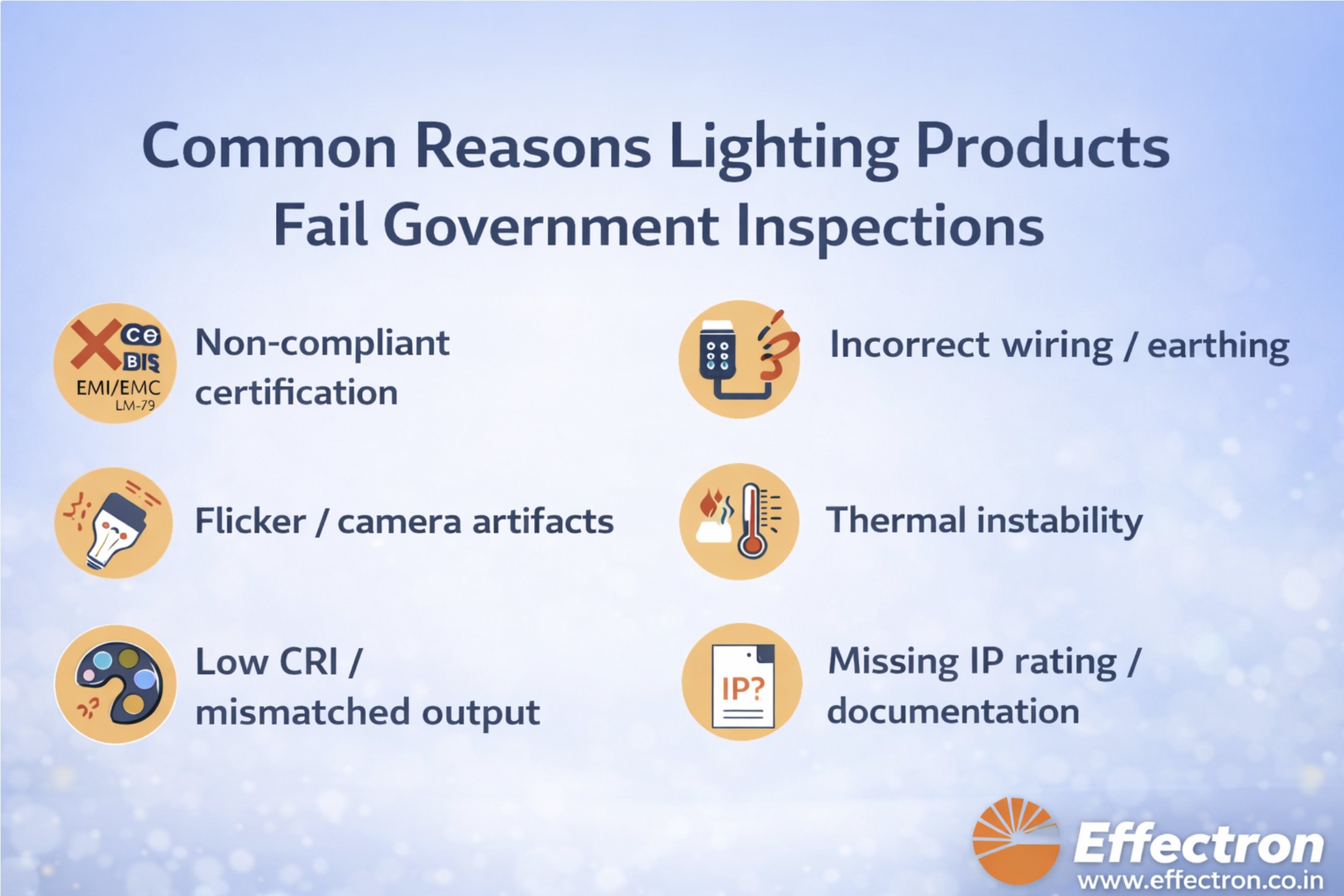
In India, government agencies like CPWD, PWD, Prasar Bharati, MES or other state agencies perform inspections for stage lighting, electrical, stage furnishing products. These agencies are responsible to ensure compliance, safety, and documentation gaps. First, missing or invalid certifications immediately raise objections during preliminary scrutiny. Next, electrical safety issues, especially earthing and cable sizing, trigger instant rejection on site. Additionally, non-compliant fire-rated cables and poor routing violate statutory installation norms. Meanwhile, performance mismatches, such as low lux levels or visible flicker, fail functional demonstrations. Further, improper mounting, unsafe rigging, and poor workmanship attract serious safety observations. Moreover, control system issues like unstable DMX or incorrect addressing disrupt live demonstrations. Finally, incomplete handover documents and weak traceability delay approvals and prevent final inspection clearance.
Effectron has worked on 100’s of CPWD, PWD, Doordarshan and other projects, and here we summarize ready pre-inspection Check List for an auditorium (stage + hall lights). Use suggest that anyone working on auditorium uses this as a “walkthrough checklist” pre-inspection.
1) Missing or Invalid Compliance Documents.
During inspections, compliance failures often begin when approved makes and models do not exactly match supplied equipment. Additionally, inspectors verify that every fixture includes datasheets, wiring diagrams, photometric files, and formal warranty letters. Furthermore, all certificates and test reports must be traceable to the same OEM or bidder name. Meanwhile, certificate validity dates and accredited laboratory details are carefully cross-checked for authenticity. Similarly, cable compliance is confirmed through FR, FRLS, or LSZH certificates with proper batch traceability. Moreover, driver and power supply certifications, including surge protection ratings, must align with tender specifications. Finally, a complete as-built documentation set, including SLDs, circuit schedules, layouts, and focusing plans, is mandatory for approval.
2) Electrical Safety Issues
During inspection, electrical safety checks begin with verified earth continuity for all fixtures, trusses, racks, conduits, and distribution boards. Next, earth resistance must meet site limits, supported by dated and instrument-tagged records. Additionally, insulation resistance test results for all lighting circuits must be properly documented. Meanwhile, distribution boards should have correct MCB, RCBO, and RCCB ratings with complete labeling and required spare ways. Furthermore, neutral and earth separation must be correct, with secure terminations, ferrules, and proper glands. Finally, cable sizing must match load and voltage-drop calculations, ensuring drivers operate without overheating.
3) Fire & cable non-compliance
During inspections, fire and cable routing compliance is closely examined for safety and long-term reliability. First, FR, FRLS, or LSZH cables must strictly match approved BOQ specifications, without mixing lower-grade alternatives. Additionally, fire-stop sealing at wall and floor penetrations must be properly executed using approved sleeves and certified sealants. Moreover, all fire-stop locations should be documented with photographs, locations, and material details for inspection records. Meanwhile, cable trays must have adequate supports, correct spacing, smooth bends, and clear segregation between power and signal cables. Furthermore, all junction boxes must remain accessible, securely covered, and suitable for dusty auditorium environments. Finally, the installed IP ratings must match specifications to prevent fire risk, dust ingress, and inspection non-compliance.
4) Fixture installation & rigging safety (stage + FOH)
During inspection, fixture installation and rigging safety are closely evaluated across stage and FOH areas. First, all suspended fixtures must use correct clamps, secondary safety chains, and load-rated hardware. Additionally, truss and pipe grids require verified load calculations and rigging certificates where applicable. Moreover, mounting anchors must be correctly graded, with no temporary or improvised fasteners allowed. Furthermore, service access must remain clear, while sharp edges are properly protected. Finally, every fixture must display permanent nameplates showing model, power rating, serial or batch number, and IP rating.
5) Lighting performance
1. Luminaire Performance (Lux Level, Beam Angle, Focus)
During inspection, luminaire output must strictly match the approved auditorium lighting design and calculations. Measured lux levels must meet requirements for house lighting, stage wash, aisles, and emergency areas. Beam angles must align with approved drawings, ensuring uniform coverage without glare in audience sightlines. Fixture focusing and aiming must appear precise, stable, and free from spill light or visible hot spots.
2. EMI Interference and Flicker Control
Lighting systems must operate without electromagnetic interference that affects control or nearby AV equipment. Flicker testing using cameras or slow-motion capture is essential, especially for stage and front lighting. Drivers must support high-frequency operation to eliminate visible banding during broadcast, recording, or live projection.
3. Thermal Stability and Driver Shutdown
All luminaires must demonstrate thermal stability under continuous operation. After 45–60 minutes of runtime, output must remain consistent without dimming or color shift. Drivers and power supplies must not overheat or shut down, ensuring reliable performance during extended events and official demonstrations.
6) Controls
During inspections, control systems must demonstrate stable operation, clear documentation, and predictable performance.
– First, DMX lines must use approved cable types, proper termination, clean routing, and avoid star wiring.
– Next, a complete patch list must define universes, channels, fixture IDs, and physical labeling on each fixture.
– Additionally, console show files must be backed up and provided on USB during handover.
Meanwhile, live scene changes should respond instantly without signal dropouts or flicker. Further, DALI or architectural dimming systems require finalized addressing reports and verified group assignments. Finally, commissioning sheets must confirm testing, scene programming, and successful integration with electrical and safety systems.
7) Emergency + statutory requirements
During statutory inspections, emergency and exit lighting must operate reliably on backup power and remain clearly labeled for instant identification. Additionally, aisle and step lights must function continuously to ensure safe audience movement during power failures. Moreover, lighting circuits for emergency systems must remain segregated from normal lighting circuits without shared protection devices. Furthermore, metallic handrails, steps, and nearby metal structures must be properly earthed and bonded to prevent electric shock risks. Consequently, earthing continuity and bonding integrity must be verified, documented, and demonstrated during inspection walkthroughs.
8) Handover folder
Finally, CPWD and PWD inspections strongly depend on a complete and well-organized handover folder. First, keep one printed file and one USB ready for submission. Next, include all electrical test reports such as IR, earth continuity, earth resistance, and functional records. Additionally, attach detailed make and model lists with serial numbers, drivers, and recommended spares. Moreover, provide valid warranty certificates and clearly defined AMC terms, if applicable. Further, submit approved as-built drawings, control schematics, and complete addressing or patch sheets. Lastly, add O&M manuals, maintenance schedules, troubleshooting guides, and site photographs showing DB labeling, cable trays, fire-stops, and earthing points.
Quick “day before inspection” drill (30–45 minutes)
- Switch on all zones, run 1 hour.
- Do a live demo: house scenes, aisle scenes, stage presets, blackout, emergency check.
- Open DB: verify labeling + RCCB trip test + thermal/loose termination scan.
- Walk stage rigging: safety chains + clamp check + cable dressing.
- Show the handover folder—make it easy for the JE/AE/EE to sign off.
Effectron Promise
Performance you can see. Compliance you can trust.
For certified Stage Lighting, Studio Lighting, Electrical Control Systems, and Turnkey AV Solutions, Effectron delivers solutions engineered for India—and trusted worldwide.