Virtual Production (VP) has rapidly shifted from an experimental filmmaking technique to a mainstream production standard, powering global blockbusters, OTT studios, esports, and corporate content. With LED walls, camera tracking, and real-time rendering becoming more accessible, studios worldwide are upgrading not just their cameras and servers—but their lighting systems.
Why?
Because lighting is the glue that binds the real and virtual worlds. If it fails, the illusion collapses.
This post explores the specialized lighting required for Virtual Production, why conventional stage lights aren’t enough, and what studios should prioritize when designing a VP lighting ecosystem.
🎥 Why Virtual Production Needs Specialized Lighting
Traditional stage lighting focuses on illumination, contrast, and mood. In Virtual Production (VP) environment, light must do that plus:
- Match virtual scene lighting in real time
- Avoid reflections and artifacts on LED walls
- Maintain perfect color consistency across camera sensors and rendering engines
- Support camera tracking, timecode sync, and metadata workflows
A Virtual Production studio light must perform like broadcast lighting, theatre lighting, and film lighting—all at once.
🔑 Key Lighting Challenges in Virtual Production
| Challenge | Why it Happens | What You Need |
|---|---|---|
| Moiré & Flickering | LED wall refresh conflicts with camera shutter | High-frequency driver (10,000+ Hz) |
| Mismatched Color | LED walls emit different spectral profiles | CRI 95+, TLCI 95+, high R9 value |
| Harsh Spill Light | Light spills onto LED surfaces | Adjustable beam control, shutters, barn doors |
| Unrealistic Shadows | Virtual sun/sky doesn’t match practical light | DMX/RDM-controlled interactive lighting |
| On-Set Color Drift | Camera LUTs vs. light spectrum collision | Broadcast-grade calibration |
Lighting design in Virtual Production is less about fixtures, more about engineering the ecosystem.
🌐 Types of Specialized Lighting Used in Virtual Production
1️⃣ Fresnel & Profile Spot Lights
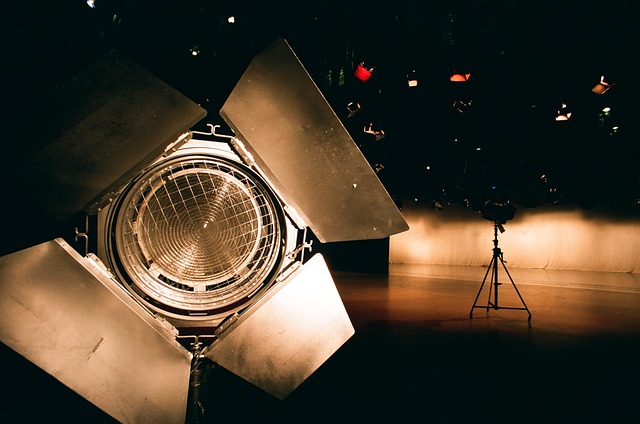
LED Fresnel LED Profile Lights used for key light and directional texture for faces and objects.
- 200–300W COB LED
- CRI > 95 / TLCI > 95
- Motorised zoom (10°–50°)
- RDM/DMX for real-time virtual sync
💡 Ideal for: Facial modeling, directional highlights, cinematic shadows
2️⃣ Soft Lighting Systems
LED Soft Light sources replicate diffuse natural light—windows, skylight, bounce.
- LED panels with no-flicker drivers
- RGBWW for skin tone accuracy
- Tunable white 2,700K–6,500K
- High-speed flicker-free at 10,000 FPS
💡 Ideal for: Naturalistic cinematic looks, interviews, corporate sets
3️⃣ Cyclorama & Floor Wash Lights
LED Cyclorama Lights are used to transition environmental lighting from LED walls to set pieces.
- RGBWA 5-in-1 color mixing
- 40°–60° beam
- Master/Slave grouping
- Silent cooling systems
💡 Ideal for: Blending physical & digital environments
4️⃣ Practical & Interactive Lights
Lights that respond to virtual events.
Examples:
- Engine flare lights
- Screen reflection enhancers
- Weapon muzzle flashes
- Interactive color changes in sync with Unreal Engine
💡 Result: Real-world light reacts to virtual events → immersion
🛠️ Lighting Control & Integration
Control Workflow Checklist
| Layer | Protocol | Purpose |
|---|---|---|
| Fixture-Level | DMX512 / RDM | Addressing, Monitoring, Metadata |
| Show Control | Art-Net / sACN | Networked Lighting Over IP |
| VP Sync | Genlock / Timecode | Camera & Render Synchronisation |
| Engine Link | Unreal / Disguise / Pixotope | Event-based lighting triggers |
A VP lighting network is closer to a broadcast IT stack than a theatrical setup.
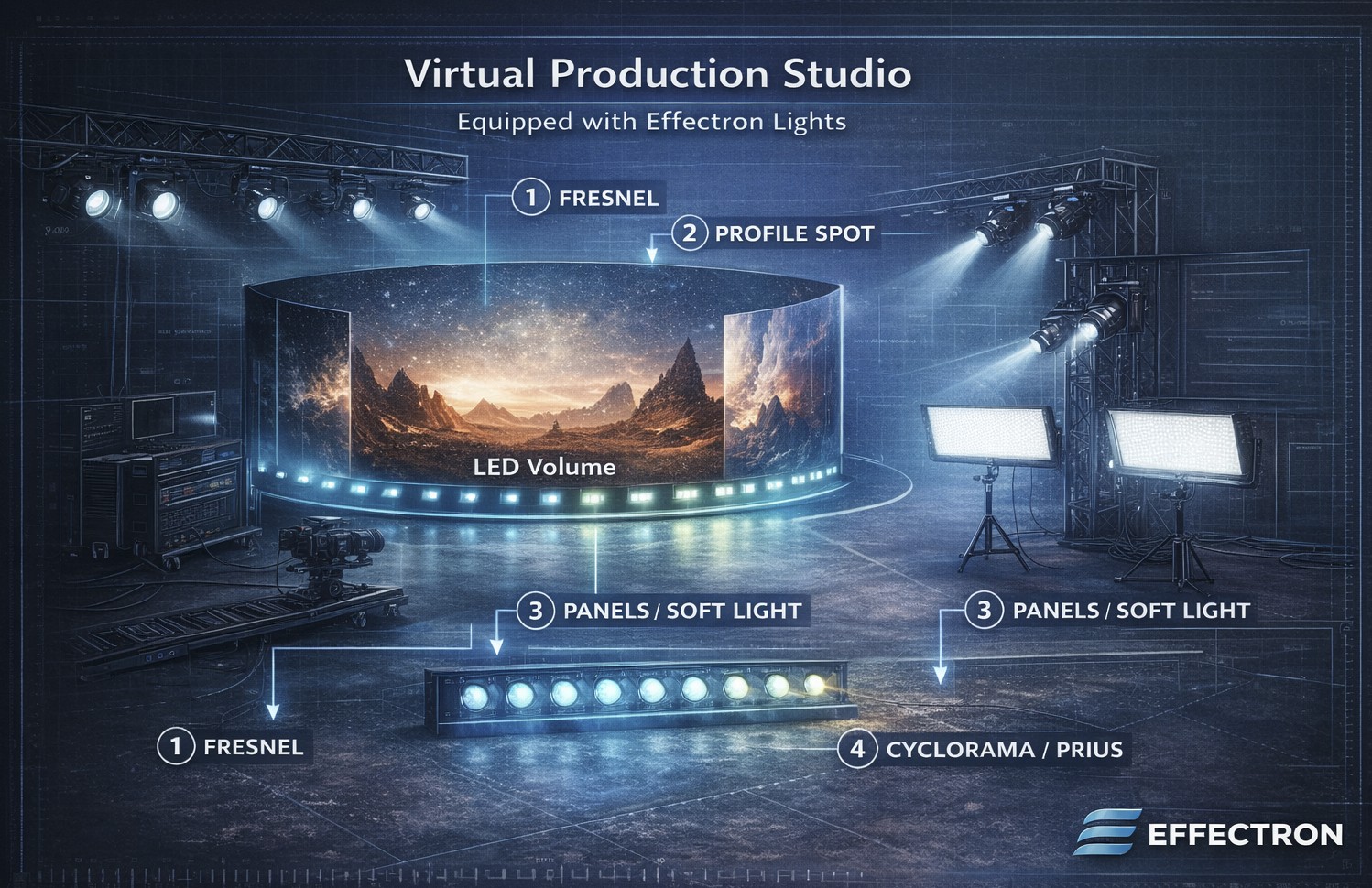
🚧 Real-World Studio Setup Example

Image above describes how real-time lighting becomes part of the rendering pipeline.
🧱 What Studios Should Look for When Purchasing Lights
Essential Specs Checklist
- CRI/TLCI 95+
- Flicker-free at 10,000+ FPS
- Tunable white (2,700K–6,500K)
- RDM-capable
- IP-rated drivers (for heat stability)
- Beam control tools (barn doors, gobos, iris)
- High R9 (≥90) for skin tones
Bonus Must-Haves
- 15°–38° zoom range for profiles
- Fanless or silent thermal systems
- LM79 / CE / BIS / UL certified depending on region
- Integration with Unreal Engine triggers (via console/server)
🎛️ Who Benefits from Virtual Production -Optimized Lighting?
- Enterprise Virtual Production studios
- XR Weather/news broadcast rooms
- Esports analysis floors
- Corporate training & education studios
- Virtual showroom & product launch stages
- Film studios building hybrid sets
Virtual Production is no longer only for cinema.
It’s becoming the default standard for modern content.
🚀 Final Thoughts
Specialized lighting in Virtual Production is not just about brightness and color—it’s about digital compatibility. Lights now communicate, sync, respond, and behave like part of a computer network. Effectron’s pixel controlled lights
If cameras, servers, and LED walls are the brain of Virtual Production, lighting is the eye.
It determines whether the audience sees magic—or sees the trick. Studios investing in VP should prioritize lighting with the same seriousness as they do tracking systems and graphics engines. Because the future of storytelling depends not just on what you render, but how you light the reality you blend it with.
Effectron Promise
Performance you can see. For certified Virtual Production Lights Effectron delivers solutions engineered for India—and trusted worldwide. Contact us at info@effectron.co.in or call us at +91-9310346440